




| IN A NUTSHELL |
|
In a strategic move that underscores the shifting dynamics of global technology, Huawei Technologies has unveiled its latest AI supercomputing system, the CloudMatrix 384, at the World Artificial Intelligence Conference 2025 in Shanghai. Designed with 384 Ascend 910C processors, this system promises to deliver twice the computing power of Nvidia’s GB200 NVL72. While Huawei positions itself as a formidable player in the AI landscape, the launch highlights broader implications for the U.S. and China in the tech arena. As the world watches the evolution of AI infrastructure, questions about market dominance and technological sovereignty come to the fore.
U.S. Curbs Fuel Huawei’s Rise in China
In recent years, U.S. export controls have inadvertently fueled Huawei’s rise in China’s AI sector. By restricting the sale of advanced AI chips like Nvidia’s H100 and Blackwell to Chinese companies, the U.S. has created a vacuum that Huawei is eager to fill. Analysts predict that Huawei’s share of China’s AI chip market could grow from 23% to 28% by 2025. This growth is occurring against the backdrop of a projected $36 to $39.5 billion in AI chip spending within China this year alone. Major players such as Alibaba and ByteDance are leading the charge in AI infrastructure investments, contributing to a broader capital expenditure in the sector that is expected to reach approximately $91 billion.
Despite these promising developments, Huawei’s influence outside of China remains limited. The U.S. Commerce Department has made clear that utilizing Huawei’s Ascend chips in global markets could breach export laws, thereby confining Huawei’s expansion to its domestic market. This restriction serves to maintain Nvidia’s stronghold in international markets, even as its presence in China faces new challenges.
Nvidia Still Leads the Global Market
While Huawei’s advancements are notable, Nvidia retains its leadership position in the global AI market. Investors continue to monitor developments in China closely, recognizing Huawei’s progress as a testament to how export policies are reshaping the AI supply chain. Despite the restrictions imposed by the U.S., Nvidia’s stock remains robust, buoyed by a Smart Score of 8 and a strong buy consensus among Wall Street analysts. Globally, Nvidia’s extensive data center exposure remains a focal point for investors, though the increasing self-sufficiency of China’s chip industry is becoming an undeniable factor in investment strategies.
The resilience of Nvidia’s stock in the face of these challenges highlights the company’s strategic positioning and its robust market fundamentals. However, as Chinese firms like Huawei continue to innovate and expand their capabilities, the global landscape may shift in unexpected ways.
Nvidia’s Stock Performance and Projections
As of now, Nvidia’s stock continues to attract attention from Wall Street analysts. The company enjoys a strong buy consensus, with an average stock price target of $184.91, indicating a potential upside of 6.58%. This positive outlook reflects confidence in Nvidia’s ability to navigate the complexities of the global AI market. Investors are particularly interested in the company’s data center exposure, which remains a key driver of growth. Despite the competitive pressures from domestic markets like China, Nvidia’s global reach and technological prowess offer a solid foundation for continued success.
As the AI industry evolves, Nvidia’s adaptability and innovation will be crucial in maintaining its leadership position. The ongoing developments in China serve as a reminder of the changing dynamics in the tech industry and the importance of strategic foresight.
The Technical Edge of Huawei’s CloudMatrix 384
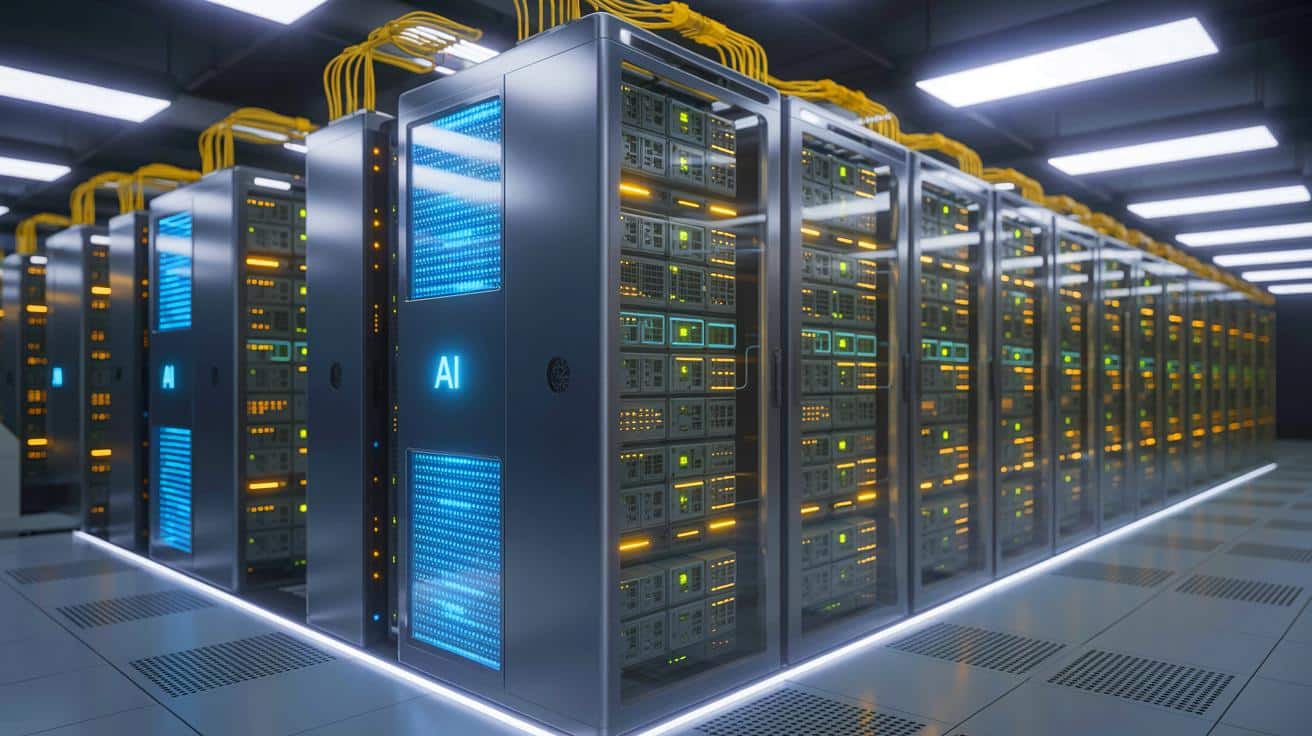
Huawei’s CloudMatrix 384 boasts impressive technical specifications that set it apart. With a peer-to-peer architecture and an optical interconnect backbone, the system facilitates high-speed, low-latency data transfers across its 16 racks. Each rack is equipped with 32 AI chips, and the system utilizes over 6,900 optical transceivers to achieve an internal bandwidth exceeding 5.5 petabits per second. Furthermore, the CloudMatrix 384 features 49.2 terabytes of high-bandwidth memory, offering more than triple the memory capacity of Nvidia’s comparable platform. However, these advancements come at a cost, as the system consumes approximately 559 kilowatts of power, four times more than its rival.
The technical prowess of the CloudMatrix 384 underscores Huawei’s commitment to pushing the boundaries of AI capabilities. Yet, as the global market remains beyond its reach due to export restrictions, the question remains: how will Huawei leverage this technology to solidify its standing within China?
As Huawei and Nvidia continue to navigate the complex landscape of the AI industry, the implications for global technology markets are profound. With U.S. export controls shaping the competitive environment and domestic innovations challenging established players, the future of AI development is anything but certain. As companies strategize to maintain their competitive edge, how will these dynamics influence the global tech ecosystem in the years to come?