




| IN A NUTSHELL |
|
The rediscovery of the ancient dye known as Egyptian Blue has opened a captivating chapter in the study of historical pigments. This remarkable journey was spearheaded by a team of Washington State University engineers, who successfully recreated the ancient formula lost for centuries. The dye, revered in antiquity for its striking resemblance to turquoise and lapis lazuli, holds more than aesthetic appeal. The modern recreation of this pigment is shedding light not only on ancient technologies but also on potential new applications in today’s world.
The Enigmatic History of Egyptian Blue
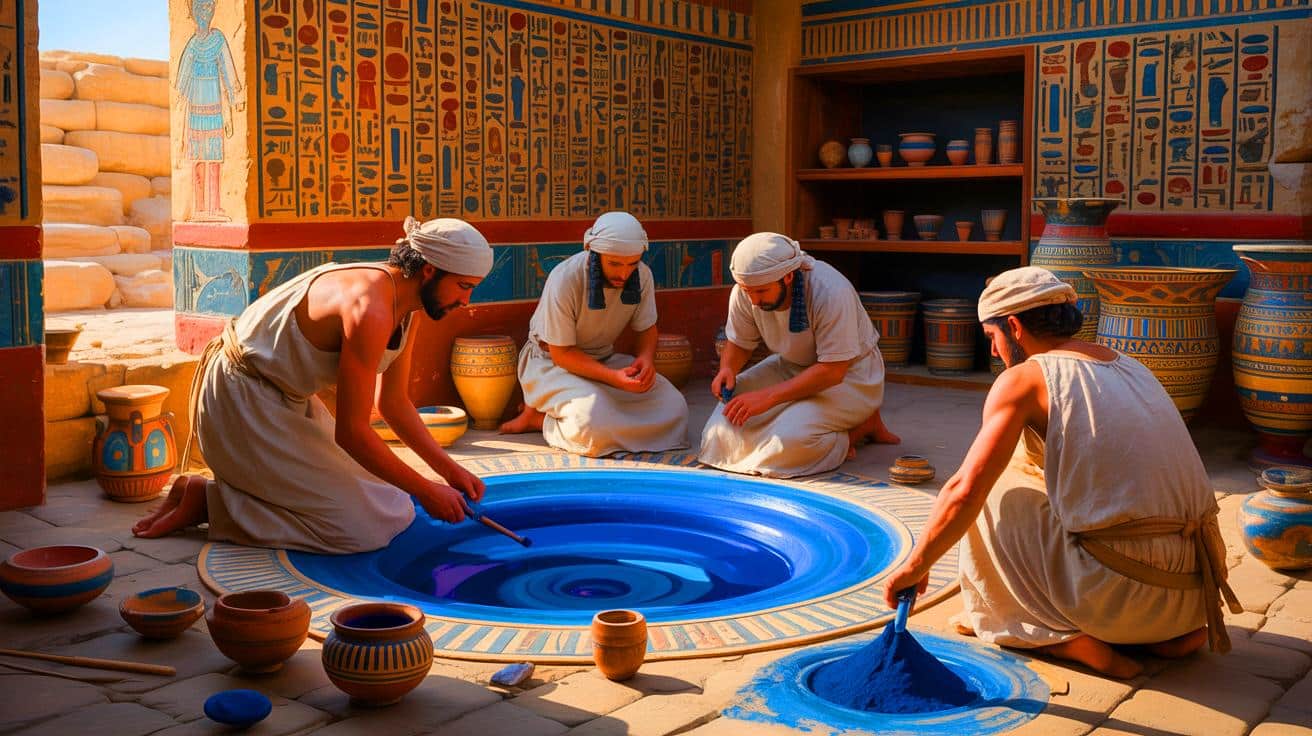
Egyptian Blue, the world’s oldest synthetic pigment, has a storied past that traces back over 5,000 years. It was widely used in ancient Egypt for painting wood, stone, and cartonnage, a material similar to papier-mâché. Despite its extensive use, the method of its creation became a mystery over time, much like the construction secrets of the Egyptian pyramids. By the Renaissance, the precise technique for crafting this vibrant hue had vanished from historical records.
The WSU team embarked on a quest to uncover this lost formula, aiming to unlock the secrets held within ancient artifacts. Collaborating with experts from various fields, including a mineralogist and an Egyptologist, they explored the pigmentation of artifacts held in renowned institutions like the Carnegie Museum of Natural History and the Smithsonian’s Museum Conservation Institute. Their research revealed that Egyptian Blue was not a uniform shade but varied from deep blue to muted gray or green, likely due to the diverse preparation methods of ancient artisans.
The Scientific Process of Recreating Egyptian Blue
Back in the laboratory, the WSU researchers developed a series of 12 potential recipes for Egyptian Blue, using materials that would have been accessible to ancient artisans. These included a mix of silicon dioxide, copper, calcium, and sodium carbonate. The team subjected the mixtures to high temperatures, approximately 1,832 degrees Fahrenheit, and varied the cooking times from one to 11 hours to simulate ancient production conditions.
Through microscopic analysis, the team compared their samples with ancient artifacts to evaluate the accuracy of their formulations. The results were illuminating, revealing that minor variations in the process could lead to significantly different hues. Surprisingly, they discovered that achieving a vibrant blue required only about 50% of the blue-colored components, allowing for multiple methods to arrive at the desired pigment when adhering to the basic formula.
Potential Modern Applications of Ancient Pigment
The ancient pigment’s revival is not just a historical curiosity; it offers intriguing possibilities for contemporary technology. Egyptian Blue is known to emit light in the infrared spectrum, a characteristic that presents potential applications in fields such as security and forensics. This property could be leveraged to develop counterfeit-proof inks or aid in fingerprint detection.
Moreover, the similarity in chemistry between Egyptian Blue and high-temperature superconductors suggests further technological exploration. The research team, led by John McCloy, underscores the unexpected significance of this ancient dye, revealing how historical science can inform modern innovations. The interdisciplinary collaboration highlights the multifaceted nature of this discovery, bridging the gap between historical inquiry and cutting-edge technology.
Rediscovering the Past to Innovate the Future
The journey to rediscover Egyptian Blue demonstrates the power of science in unraveling ancient mysteries. By reconstructing this lost formula, the WSU team not only deepens our understanding of ancient Egyptian technology but also opens doors to new scientific explorations. The blend of historical study and modern science exemplifies how understanding the past can inspire future innovations.
As we ponder the implications of this discovery, one cannot help but wonder: what other ancient secrets lie hidden within the artifacts of our past, waiting to be uncovered and reshaped into tools for the future? What will the next chapter in this ongoing dialogue between history and technology reveal?