


| IN A NUTSHELL |
|
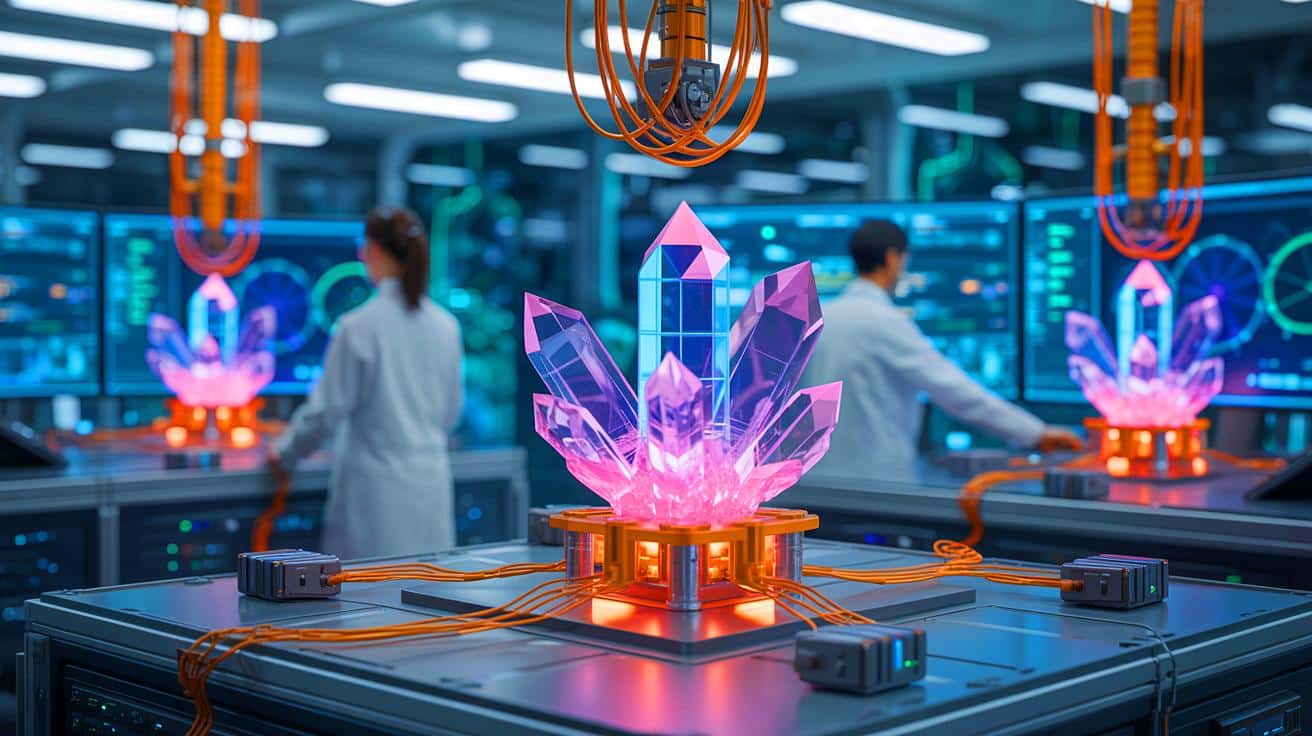
In a groundbreaking study, researchers at Aalto University’s Department of Applied Physics have made strides in the field of quantum mechanics by successfully connecting time crystals to an external system for the first time. This achievement could pave the way for revolutionary advancements in quantum computing, particularly in the development of highly accurate sensors and memory systems. The study, led by Jere Mäkinen, explores the potential of time crystals to perform perpetual motion, a feat previously thought impossible when connected to external systems. This discovery marks a significant milestone in understanding and utilizing quantum systems, offering a glimpse into a future where time crystals could enhance computational power and sensing capabilities.
The Concept of Time Crystals
Time crystals are a relatively new concept in the world of quantum physics. Proposed by Nobel Laureate Frank Wilczek in 2012, time crystals are defined by their ability to remain in perpetual motion without external energy input. Unlike ordinary crystals, which have a repeating structure in space, time crystals repeat in time. This unique property makes them fundamentally different from any known physical systems.
In 2016, the existence of time crystals was experimentally confirmed, sparking significant interest in the scientific community. Theoretical predictions suggested that these crystals could exhibit perpetual motion, challenging traditional understandings of thermodynamics. Time crystals have since been the subject of numerous studies, each exploring their potential applications and the underlying principles that govern their behavior.
Connecting Time Crystals to External Systems
The recent study conducted by Aalto University researchers marks a significant advancement in the field. By transforming a time crystal into an optomechanical system, they demonstrated its potential for real-world applications. The researchers used radio waves to introduce magnons into a Helium-3 superfluid, which was cooled to near-absolute zero temperatures. When the radio wave pump was turned off, the magnons formed a time crystal that remained in motion for several minutes, completing up to 108 cycles before fading.
During the fading process, the time crystal interacted with a nearby mechanical oscillator. This interaction was influenced by the oscillator’s frequency and amplitude, showcasing a phenomenon similar to well-known optomechanical processes. This discovery opens up new possibilities for manipulating time crystals, allowing scientists to adjust their properties for various applications. The ability to connect time crystals to external systems could lead to new technologies that leverage their unique characteristics.
Observing Changes in Frequency
“We showed that changes in the time crystal’s frequency are completely analogous to optomechanical phenomena widely known in physics,” said Jere Mäkinen.
This statement underscores the significance of the study’s findings. By observing changes in the frequency of time crystals, the researchers drew parallels with optomechanical processes used in advanced scientific experiments, such as those conducted at the Laser Interferometer Gravitational-Wave Observatory in the U.S. These processes are crucial for detecting gravitational waves, illustrating the potential of time crystals to contribute to cutting-edge scientific research.
Through their experiments, the researchers demonstrated that it is possible to reduce energy loss and increase the frequency of the mechanical oscillator connected to the time crystal. This optimization could bring the setup closer to the quantum realm, enhancing the precision and effectiveness of quantum systems. The ability to control and manipulate the frequency of time crystals could lead to transformative advancements in various fields, including quantum computing and high-sensitivity measurement devices.
Potential Impact on Quantum Computing
The implications of this research extend far beyond theoretical physics. Time crystals could play a pivotal role in advancing quantum computing technologies. According to Mäkinen, time crystals have the potential to outlast current quantum systems used in computing. Their ability to sustain motion for extended periods could revolutionize memory systems, providing greater stability and efficiency.
Moreover, time crystals could be employed as frequency combs, which serve as reference points in high-sensitivity measurement devices. These devices rely on precise frequency measurements for accurate data collection, making time crystals a valuable asset in scientific experiments and technological applications. As researchers continue to explore the capabilities of time crystals, their integration into quantum computing systems could lead to unprecedented improvements in processing power and data accuracy.
The successful connection of time crystals to external systems represents a significant leap forward in the field of quantum mechanics. As researchers further investigate the properties and applications of these unique systems, the potential for groundbreaking advancements in technology and science becomes increasingly apparent. The ability to harness the perpetual motion of time crystals could transform quantum computing and sensing, offering new possibilities for innovation. What other unexplored potentials might time crystals hold for the future of technology and science?