



| IN A NUTSHELL |
|
The discovery of what may be the largest black hole ever recorded has sent ripples through the scientific community. This cosmic behemoth, estimated to be 36 billion times the mass of our Sun, resides in the heart of the Cosmic Horseshoe galaxy. This finding challenges existing theories about black hole formation and growth. Using innovative observation techniques, astronomers have measured its gravitational pull with unprecedented accuracy, providing a rare opportunity to study one of the universe’s most extreme phenomena. Situated roughly 5 billion light-years from Earth, this discovery opens new pathways for understanding the evolution of galaxies and their central black holes.
The Cosmic Horseshoe’s Gravitational Marvel
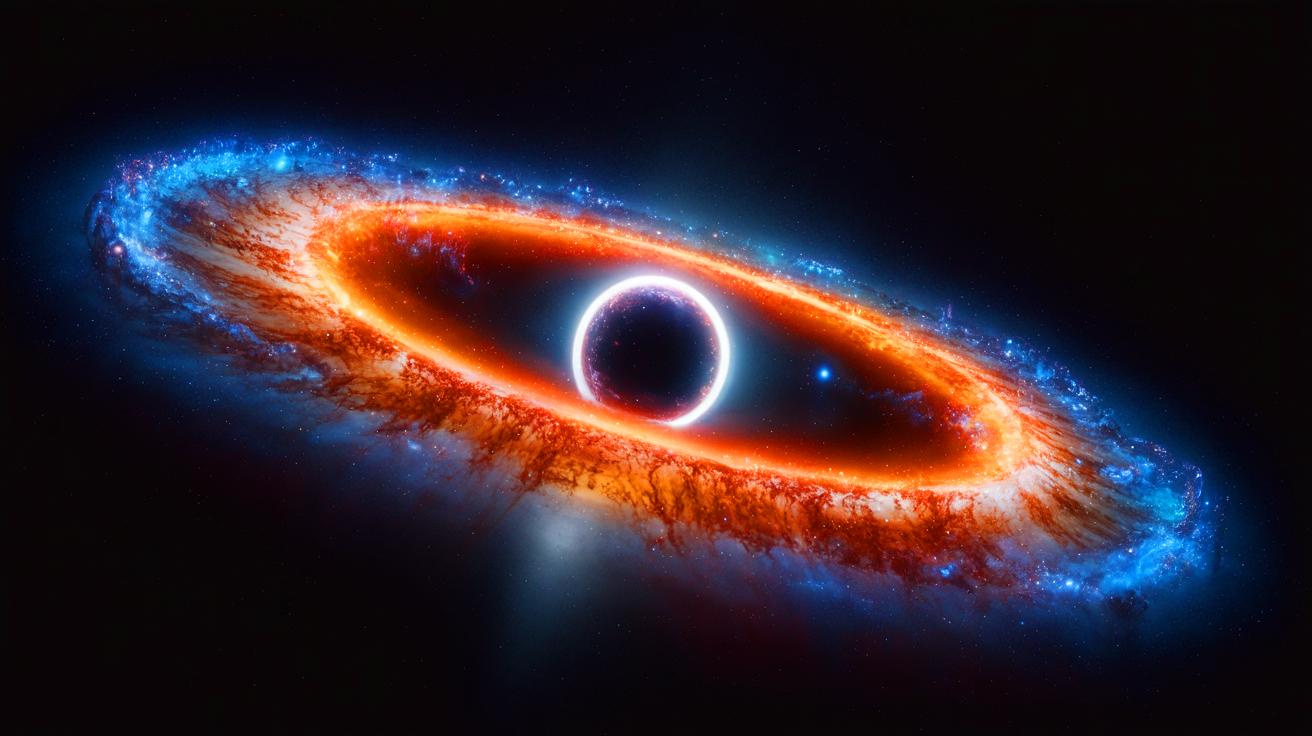
The Cosmic Horseshoe galaxy, home to this ultramassive black hole, is a spectacle of gravitational wonder. Its enormous mass bends spacetime, creating a dramatic Einstein ring, a horseshoe-shaped distortion of light from a background galaxy. This effect not only makes the galaxy visually striking but also plays a pivotal role in the detection of its central black hole.
The black hole itself is a staggering 10,000 times the mass of the Milky Way’s central black hole. This immense scale nears the theoretical upper limit for black hole sizes, offering scientists a unique chance to study how such colossal entities form and evolve. The discovery underscores the potential of using gravitational phenomena to uncover hidden cosmic giants, pushing the boundaries of what is considered possible in the universe.
Innovative Methods in Black Hole Measurement
Historically, measuring black holes in distant galaxies has posed significant challenges. Traditional methods rely on observing the motion of nearby stars through stellar kinematics, which is effective only for galaxies relatively close to Earth. However, these techniques fall short when dealing with vast cosmic distances.
To overcome these limitations, researchers employed a dual-method approach combining stellar kinematics with gravitational lensing. The latter involves the black hole’s gravity bending and magnifying light from objects behind it, allowing for precise measurements. This breakthrough method enabled scientists to detect subtle changes in starlight and star motion, confirming the presence and mass of the black hole with remarkable certainty.
The Dormancy of a Colossal Black Hole
Remarkably, this potentially largest black hole ever discovered is dormant. Unlike active galactic nuclei or quasars, it does not actively consume gas or dust, nor does it emit high-energy radiation. Its discovery relied solely on gravitational effects, marking a rare instance where astronomers could accurately measure a silent ultramassive black hole located billions of light-years away.
This finding highlights the potential to uncover non-active galactic cores using advanced techniques. Situated about 5 billion light-years from Earth, this black hole demonstrates that even dormant giants can be detected and studied, offering insights into the nature of galaxy and black hole evolution across cosmic timescales.
The Interconnection Between Galaxies and Black Holes
Astronomers have long theorized that the growth of galaxies and their central black holes are closely linked. As galaxies expand, material is funneled inward to feed the black hole. In turn, black holes can influence their host galaxies by releasing massive amounts of energy, often in the form of quasars, which can inhibit star formation.
The Milky Way, for instance, contains a relatively modest 4-million-solar-mass black hole. Though currently quiet, it could potentially become active in the future, especially when the Milky Way eventually collides with the Andromeda galaxy in about 4.5 billion years. This interconnectedness suggests a dynamic relationship where galaxy evolution and black hole growth are mutually influential.
The Cosmic Horseshoe’s Fossil Group Legacy
An intriguing aspect of the Cosmic Horseshoe is its classification as a fossil group, a massive galaxy thought to be the remnant of several merged galaxies. Over time, its bright companion galaxies have likely been absorbed into the central giant, contributing to the black hole’s enormous size.
This process suggests that multiple supermassive black holes from former galaxies may have merged, forming the colossal entity observed today. The Cosmic Horseshoe provides a glimpse into the ‘endgame’ of galaxy and black hole evolution, where a single dominant galaxy harbors the largest black hole in the universe.
The discovery of the Cosmic Horseshoe’s ultramassive black hole began as a fortunate detour while mapping its dark matter distribution. This revelation paves the way for a new era in black hole research, with scientists planning to employ the European Space Agency’s Euclid space telescope to uncover more of these silent giants. As astronomers continue to refine their methods and explore the cosmos, they face the challenge of understanding how such immense black holes form and evolve. What other cosmic secrets might these dormant giants hold?