


| IN A NUTSHELL |
|
Supercomputers are the unheralded titans of modern technology, wielding computational power that dwarfs typical consumer devices. While your average laptop might boast a single CPU and GPU, these colossal machines house thousands of each, enabling them to process staggering amounts of data at unimaginable speeds. Used in fields as varied as national security, climate science, and artificial intelligence, supercomputers have become indispensable tools for tackling some of the world’s most complex challenges. As they continue to evolve, their capabilities push the boundaries of what is possible, driving forward innovation across multiple disciplines.
The Anatomy of a Supercomputer: More Than Just Power
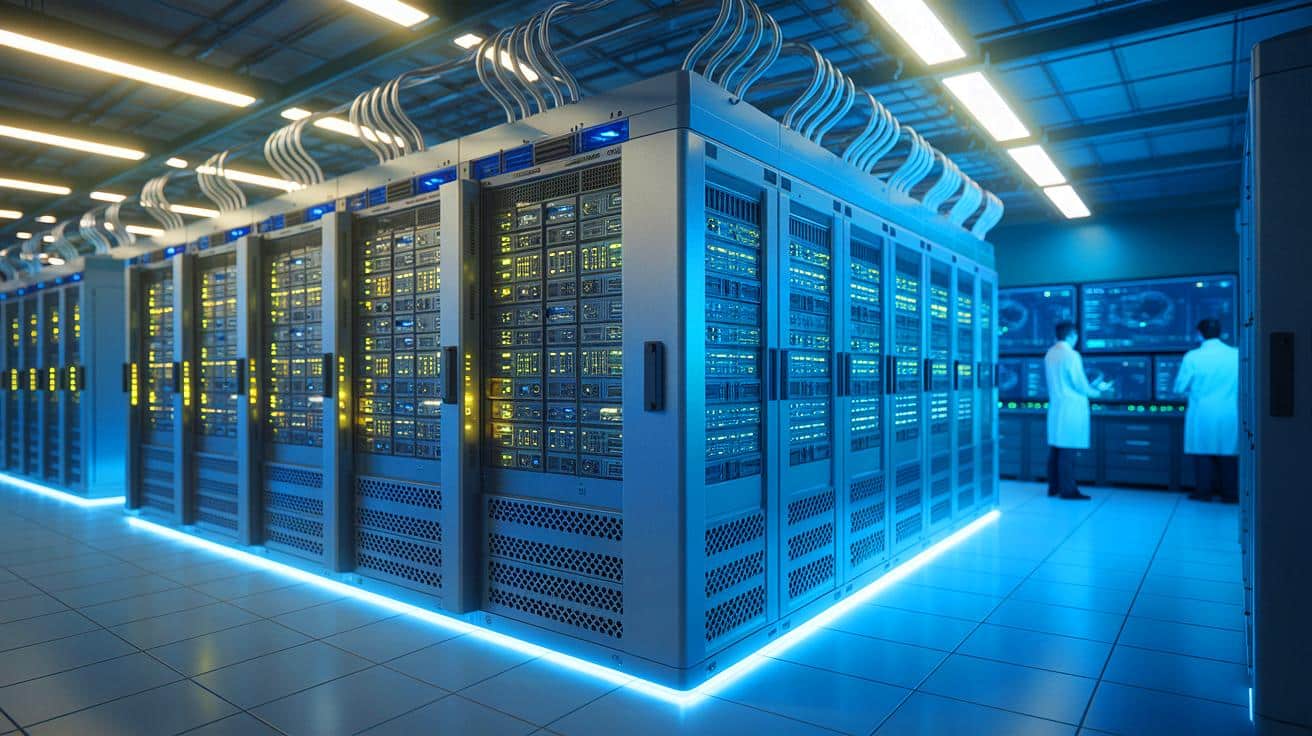
At its core, a supercomputer operates on the same principles as your everyday computer, but with a monumental difference in scale. The architecture of these machines is designed to handle complex calculations with unprecedented speed and accuracy. Unlike standard PCs, which typically feature a single CPU and GPU, supercomputers are outfitted with thousands of each, each far more powerful than consumer-grade components.
This architectural complexity allows supercomputers to achieve processing speeds measured in floating-point operations per second, or FLOPS. While a standard laptop might manage several hundred gigaFLOPS, the most powerful supercomputers operate in the realm of exaFLOPS, performing quintillions of calculations per second. This prowess makes them ideal for applications that demand both speed and precision, such as climate modeling, drug discovery, and cryptography.
“The most powerful supercomputer in the world now exceeds 1 exaFLOP, 1 quintillion (1018) FLOPS.”
https://www.caernarfonherald.co.uk/these-devices-are-beyond-human-comprehension-mind-blowing-ai-designed-gravitational-wave-detectors-baffle-scientists-worldwide/307/
El Capitan: A New Era in Computing Power
El Capitan, the world’s most powerful supercomputer, exemplifies the next frontier in computational capabilities. Located at the Lawrence Livermore National Laboratory in California, this machine was first brought online in November 2024 and is designed to bolster national security by simulating the U.S. nuclear stockpile in the absence of live testing.
With a staggering performance of 1,742 petaFLOPS, El Capitan is not merely a tool for national defense. It also serves as a platform for advancements in artificial intelligence and machine learning. The Department of Energy commissioned El Capitan as part of the CORAL-2 program, replacing the older Sierra machine. This investment underscores the critical role of supercomputers in maintaining national security and technological leadership.
The implications of El Capitan’s capabilities extend beyond defense. Its potential applications in materials science and physics could lead to breakthroughs that benefit society at large, from more efficient energy sources to advanced medical treatments.
Frontier: Pioneering the Exascale Era
Frontier, housed at the Oak Ridge National Laboratory in Tennessee, holds the distinction of being the first exascale computer ever built. Operational since August 2022, Frontier was initially conceived for applications in cancer research, drug discovery, and nuclear fusion, among others.
With a performance of 1,353 petaFLOPS, Frontier has been pivotal in advancing scientific research. It is utilized for designing new transport technologies, developing more efficient engines, and even simulating the evolution of the Milky Way. This breadth of application highlights the machine’s versatility and its role in fostering interdisciplinary collaboration.
Frontier’s contributions to scientific endeavors illustrate the transformative potential of exascale computing, offering glimpses into a future where complex problems can be tackled with unprecedented efficiency.
Aurora and Eagle: The Next Generation of Innovation
Aurora, located at the Argonne National Laboratory in Illinois, represents the next leap in supercomputing power. As the second exascale supercomputer, Aurora boasts a performance of 1,012 petaFLOPS and is designed to reach up to 2 exaFLOPS. Its capabilities are directed towards modeling and simulation across various domains, including climate science and energy storage.
Meanwhile, Microsoft’s Eagle supercomputer offers a unique approach by existing in the cloud. Based on the Microsoft Azure platform, Eagle allows users worldwide to access its immense computational resources. This democratization of supercomputing power marks a significant shift in accessibility, enabling more researchers to leverage cutting-edge tools for their work.
Both Aurora and Eagle exemplify the diverse approaches to harnessing supercomputing power, from centralized facilities to distributed cloud-based systems, each contributing to the broader scientific and technological landscape.
As supercomputers continue to evolve, they promise to revolutionize fields as diverse as climate science, medicine, and national security. With capabilities that push the boundaries of what is possible, these machines are poised to tackle some of humanity’s most pressing challenges. Yet, as we marvel at their potential, we must consider the ethical and societal implications of their use. How will we balance the immense power of supercomputers with the responsibility to use them wisely and equitably?