



| IN A NUTSHELL |
|
In a groundbreaking experiment, physicists have managed to visualize the elusive Terrell-Penrose effect, a fascinating phenomenon predicted by Einstein’s theory of relativity. This scientific breakthrough, achieved by a collaboration between TU Wien and the University of Vienna, allows us to observe how objects moving close to the speed of light appear warped, confirming a key aspect of Einstein’s predictions. The experiment involved innovative techniques to simulate the effect, which had previously been impossible to capture. This achievement paves the way for further exploration into the mysteries of relativistic physics.
The Terrell-Penrose Effect: A Visual Distortion
The Terrell-Penrose effect, first proposed in 1959 by physicists James Terrell and Roger Penrose, suggests that objects moving at relativistic speeds appear rotated to an observer. According to Einstein’s special theory of relativity, as objects travel near the speed of light, they experience relativistic effects such as length contraction and time dilation. These effects have been observed in various experiments, yet the visual distortion predicted by Terrell and Penrose remained elusive until now.
Professor Peter Schattschneider from TU Wien explains that when a rocket moves past us at ninety percent of light speed, it appears 2.3 times shorter due to Lorentz contraction. However, capturing this contraction on camera is complex because light interacts differently under such conditions. The light from different parts of the object takes varying times to reach the camera, complicating the visual representation. Thus, while the object is physically contracted, the image perceived is a rotated version of its original form, an optical illusion arising from the intricate interplay of light and motion.
Light Speed Illusions and Perception
Our perception of objects is based on light reaching our eyes simultaneously, but this is not entirely accurate. Light from different parts of an object travels at a constant speed, and its arrival time at our eyes can vary depending on distance. Normally, these differences are negligible, but they become significant when an object moves close to the speed of light, causing it to appear rotated. This visual twist happens due to the combination of relativistic length contraction and the different light travel times from various points on the object.
Peter Schattschneider illustrates this by describing how a seemingly normal cube appears rotated when observed at relativistic speeds. This apparent rotation results from the simultaneous arrival of light emitted at different times from different parts of the object. Such phenomena confirm the predictions made by Terrell and Penrose, further supporting Einstein’s theory and expanding our understanding of the universe’s fundamental principles.
Innovative Techniques: Slowing Down Light
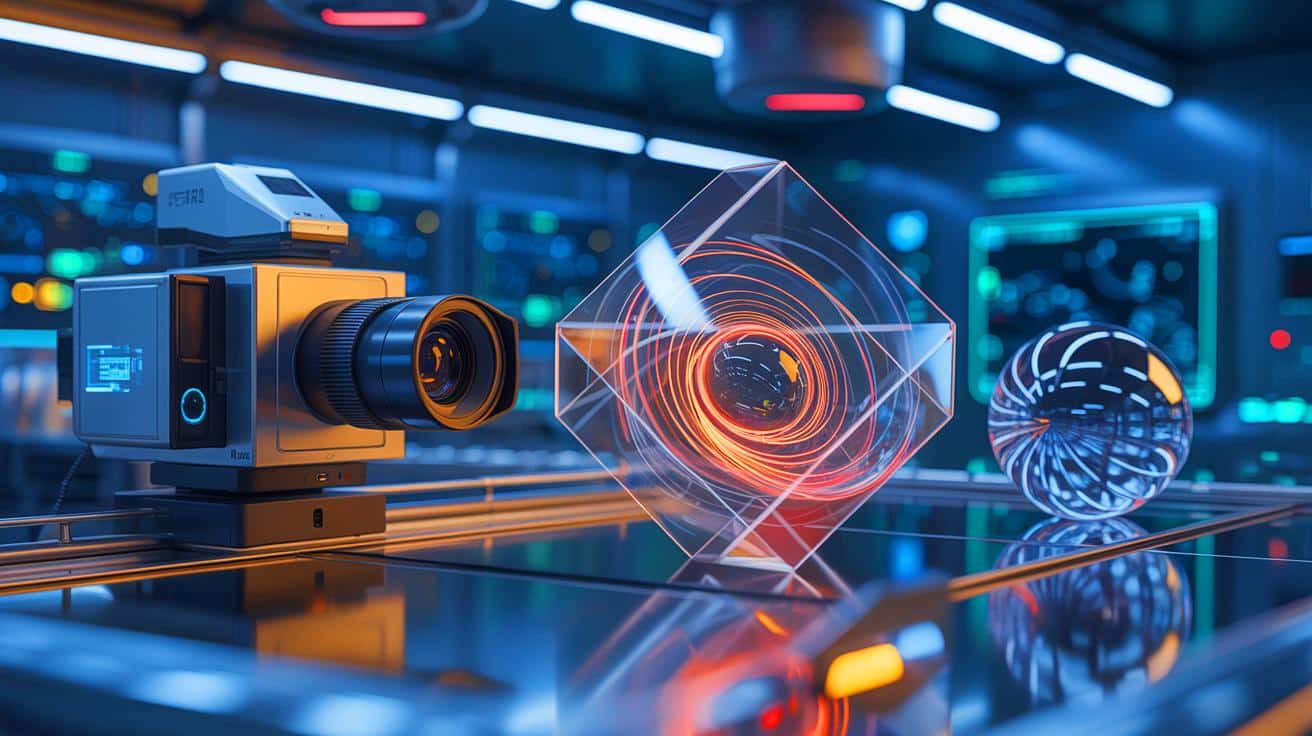
Achieving the speeds necessary to directly observe the Terrell-Penrose effect is beyond current technology. However, the team at TU Wien, led by Schattschneider, ingeniously simulated the effect in a laboratory setting. By using a high-speed precision camera and brief laser pulses, they effectively slowed down light to replicate the conditions required to observe the phenomenon.
Victoria Helm and Dominik Hornof, students involved in the experiment, described how they moved a cube and a sphere around the lab while recording laser flashes reflected from different points on these objects. By synchronizing the laser flashes and the camera’s speed, they created a scenario where light traveled at an equivalent speed of two meters per second, making the Terrell-Penrose effect visible for the first time. The resulting images, when combined into short video clips, demonstrated the expected visual distortions: the cube appeared twisted, and the sphere’s North Pole seemed displaced, confirming the theoretical predictions.
A New Era in Relativistic Physics
The successful visualization of the Terrell-Penrose effect marks a significant milestone in the field of relativistic physics. By making the optical illusion of relativistic motion observable, this experiment not only confirms a key aspect of Einstein’s theory but also opens up new avenues for research. The findings, published in Communications Physics, demonstrate the potential for further exploring the nuances of light and motion at high speeds.
As science continues to push the boundaries of what we can observe and understand, this breakthrough prompts us to consider the vast possibilities that remain unexplored. How will this new understanding of relativistic effects influence future technological advancements, and what other hidden phenomena await discovery in the vast cosmos?