




| IN A NUTSHELL |
|
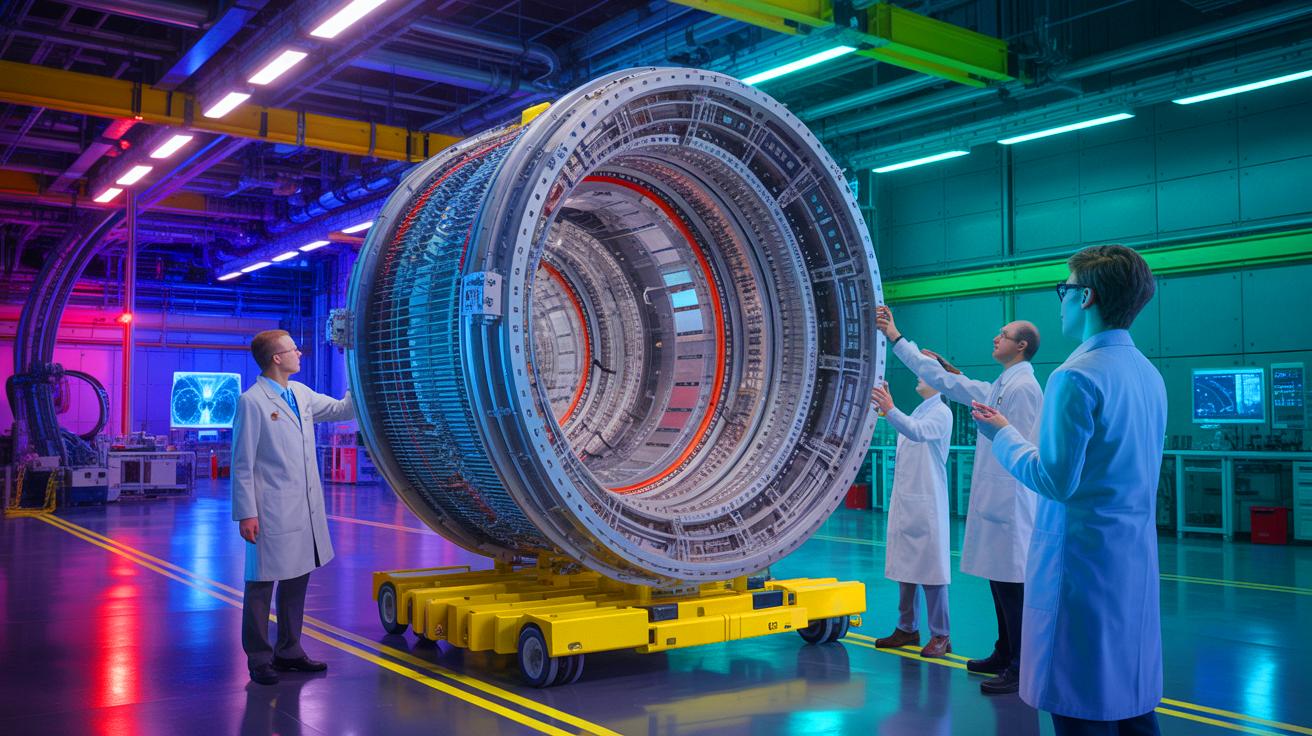
In a remarkable fusion of physics and engineering, researchers at the Department of Energy’s Oak Ridge National Laboratory (ORNL) have unveiled a mobile muon detector. This advanced system is set to transform how dense materials are probed, nuclear fuel is monitored, and challenges in quantum computing are addressed. Muons, akin to electrons but heavier, travel through matter at nearly the speed of light, making them ideal for imaging dense materials. ORNL’s detector overcomes the limitations of muons’ brief lifespan, promising new avenues for scientific and technological advancements.
Revolutionizing Nuclear Security
The ORNL muon detector promises a significant leap forward in nuclear security. By analyzing muon scattering and energy loss, the detector can create detailed images of shielded nuclear fuel canisters. This dual measurement capability, capturing both energy and scattering angles, results in clearer and more precise imaging than previous technologies allowed. Such advancements directly impact nuclear safety by enhancing the accountability of nuclear materials management.
The detector’s capabilities extend to waste disposal, providing the U.S. and global community with stronger safeguards against potential nuclear risks. By facilitating better tracking of spent nuclear fuel and aiding the development of next-generation reactors, the muon detector is positioned to play a critical role in maintaining nuclear safety and security.
Advancing Quantum Computing
Beyond its applications in nuclear science, the muon detector offers potential breakthroughs in quantum computing, a field that relies on the stability of qubits, which are highly sensitive to cosmic radiation. By examining interactions between muons and qubits, researchers aim to refine error correction methods and develop more resilient quantum hardware. This progress is crucial for scaling quantum computers beyond controlled laboratory environments.
The muon detector thus serves a dual purpose: not only ensuring nuclear safety but also pushing the boundaries of next-generation computing. The detector’s ability to address these significant challenges underscores its importance in both fields.
Interdisciplinary Innovation
The development of the muon detector underscores the power of cross-disciplinary collaboration. The idea originated during doctoral research into muon tomography but gained traction at ORNL when JungHyun Bae, a Wigner Distinguished Staff Fellow, drew inspiration from an existing neutron detector. This detector had previously been honored with a prestigious R&D 100 award. By adapting wavelength-shifting fiber technology from neutron sciences, ORNL’s team transformed a theoretical concept into a functional system within two years.
Bae expressed his excitement about bringing this vision to life, highlighting the invaluable support and innovation fostered by ORNL’s interdisciplinary community. This project exemplifies how collaborative ingenuity can drive scientific progress, turning long-standing challenges into groundbreaking solutions.
A New Era for Muon Imaging
The muon detector is set to be relocated to a specialized ORNL facility for real-world testing. This move marks the beginning of a new era for muon imaging, with the detector poised to play a crucial role in strengthening nuclear safeguards and advancing quantum computing. As testing commences, the detector’s potential to transform these fields becomes increasingly apparent.
This development illustrates how collaborative efforts can redefine the possibilities within scientific research, offering hope for resolving complex challenges through innovative solutions. The muon detector stands as a testament to the transformative power of interdisciplinary collaboration in science and technology.
As the muon detector embarks on its testing phase, its impact on nuclear security and quantum computing remains a subject of keen interest. How will this innovative technology reshape our approach to these critical fields in the coming years?