




| IN A NUTSHELL |
|
Bladeless wind turbines (BWTs) are emerging as a promising alternative in the renewable energy sector. Unlike traditional wind turbines with spinning blades, BWTs employ a different mechanism that could revolutionize energy generation. Researchers from the University of Glasgow have made significant strides in understanding these mechanisms through advanced computer simulations. By identifying optimal designs, they aim to transition BWTs from small-scale experiments to practical applications within national electricity grids. The potential benefits are substantial: quieter operation, less space required, reduced maintenance, and improved safety for wildlife. This research marks a pivotal step toward a more sustainable and efficient future in wind energy.
The Mechanics of Bladeless Wind Turbines
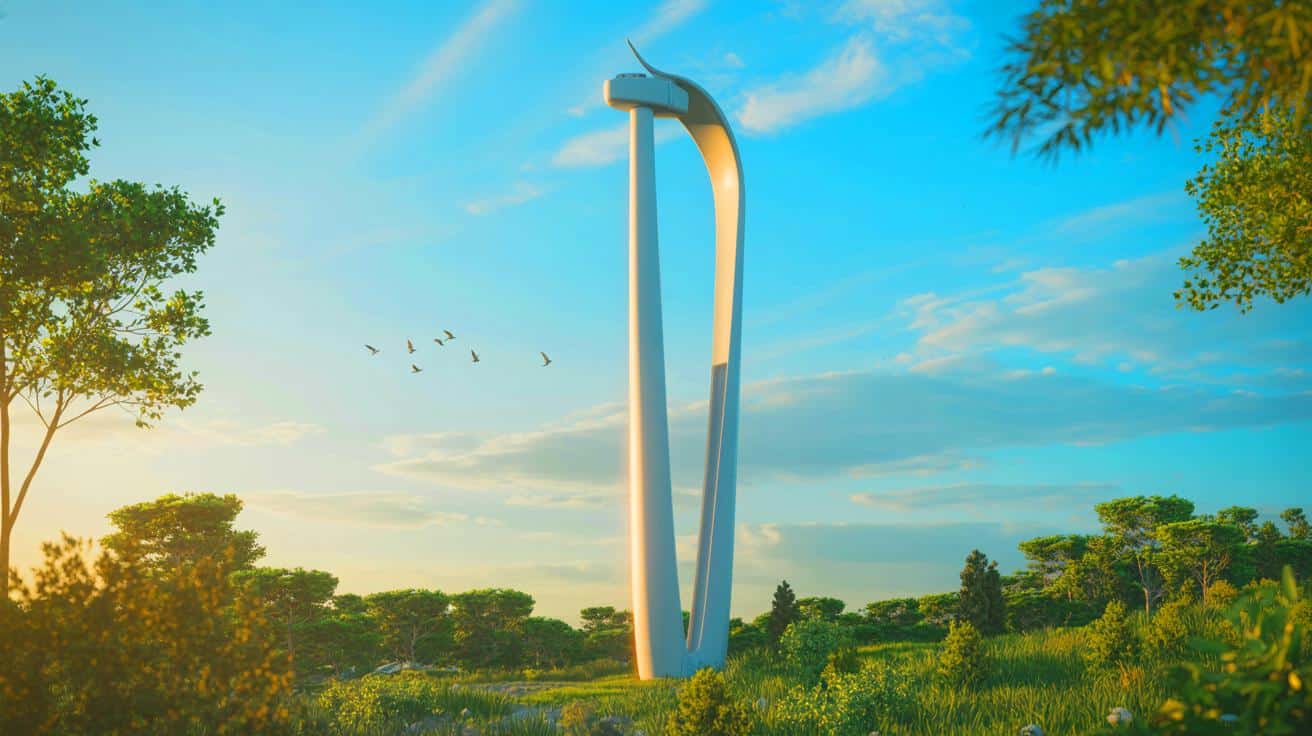
Traditional wind turbines have been integral to harnessing wind energy for decades. They function by converting the kinetic energy of wind into rotational motion, which drives a generator to produce electricity. However, bladeless wind turbines operate using a different principle known as vortex-induced vibration (VIV). These turbines consist of tall, slender masts that sway in response to wind, much like a lamppost in a breeze. The wind creates vortices around the structure, causing it to oscillate. When this motion aligns with the natural frequency of the structure, the oscillation is amplified, and the energy is converted into electricity. This method presents a novel approach to wind energy generation, offering unique advantages over conventional turbines.
The research conducted by the University of Glasgow has been instrumental in identifying optimal designs for BWTs. Through extensive simulations, the engineers have discovered that the most efficient design is not necessarily the one that produces the highest power output. Instead, they have pinpointed a specific balance between design variables that maximizes power generation while ensuring structural integrity. This insight challenges previous assumptions and opens the door to more effective BWT designs.
Advantages of Bladeless Designs
The advantages of bladeless wind turbines are numerous. One of the most significant benefits is their quieter operation compared to traditional turbines. This reduced noise pollution makes them more suitable for installation in populated areas. Additionally, BWTs occupy less physical space, allowing for more flexible placement in various environments. Their simpler design also translates to lower maintenance requirements, reducing operational costs over time.
Another critical advantage of BWTs is their safety for wildlife. Traditional turbines pose a risk to birds and bats, as the rapidly spinning blades can be difficult for these animals to detect, leading to collisions. In contrast, BWTs minimize this risk due to the absence of visible moving parts. This feature addresses a longstanding environmental concern associated with wind energy deployment. The potential for BWTs to operate safely in a range of wind conditions, from 20 to 70 miles per hour, further underscores their viability as a sustainable energy solution.
Optimizing Design for Maximum Efficiency
The University of Glasgow’s research has identified an ideal design for bladeless turbines: a mast measuring 31.4 inches in height and 25.4 inches in diameter. This configuration strikes the perfect balance between power output and structural strength, capable of generating up to 460 watts of power. This is a significant improvement over current prototypes, which generally produce around 100 watts.
The findings indicate that this optimized design can safely operate in diverse wind conditions, maintaining both efficiency and stability. The researchers are hopeful that their methodology will facilitate the scaling of BWTs to produce even more power, potentially reaching outputs of 1,000 watts or more. This advancement could considerably enhance the role of BWTs in the global energy landscape, providing a viable alternative to traditional wind power systems.
Future Prospects and Industry Implications
The implications of these findings for the renewable energy industry are profound. By demonstrating the most efficient design for BWTs, the research team aims to inspire further development and innovation in this field. The potential for BWTs to be integrated into existing energy infrastructures could significantly boost the industry’s capacity to meet growing energy demands sustainably.
Bladeless wind technology is not entirely new; companies like BMW and Aeromine Technologies have already begun exploring its potential. The installation of the first “motionless” system at the Oxford MINI Plant in the UK exemplifies the practical applications of this technology. As more industry players recognize the benefits of bladeless designs, the adoption of BWTs is likely to accelerate, paving the way for a cleaner, more efficient energy future.
The research from the University of Glasgow provides a compelling case for the widespread adoption of bladeless wind turbines. As the energy sector continues to evolve, the integration of innovative technologies like BWTs will be crucial in addressing the challenges of climate change and energy sustainability. How will the energy landscape adapt to these emerging technologies, and what role will bladeless wind turbines play in shaping the future of renewable energy?