



| IN A NUTSHELL |
|
In an unprecedented breakthrough, an international team of researchers from the University of Mainz in Germany has achieved what was once deemed impossible: the synthesis of an ultra-heavy hydrogen isotope, specifically a hydrogen atom with six neutrons. This feat was accomplished using the Mainz Microtron (MAMI) accelerator, a cutting-edge tool in particle physics. Known for its precision and stability, MAMI played a crucial role in this groundbreaking experiment. This discovery not only challenges existing nuclear models but also opens new avenues for research in nuclear physics and astrophysics. How did they achieve this remarkable success, and what does it mean for the future?
The Groundbreaking Creation of the Six-Neutron Hydrogen
The creation of the six-neutron hydrogen isotope marks a significant milestone in the field of nuclear physics. Traditionally, hydrogen is known as a simple atom consisting of one proton and one electron. Its more massive counterpart, tritium, includes two neutrons. However, the notion of an isotope with five neutrons surrounding a single proton (⁶H) was considered purely theoretical, if not unrealistic. Yet, the team at Mainz defied the odds and synthesized this isotope for the first time in history.
This achievement was made possible by utilizing a 855 MeV electron beam generated by the MAMI accelerator, renowned for its high performance in light particle physics. This extraordinary isotope is the most unbalanced nucleus documented to date, with its neutron-to-proton ratio setting a new world record. Although its stability is fleeting due to its massive weight, this discovery raises fundamental questions about nuclear forces and the limits of neutron aggregation around a single proton.
The Intricacies of the Experimental Method
The synthesis of the six-neutron hydrogen was realized through a meticulous two-step process. The researchers employed a lithium-7 (⁷Li) target, which is naturally rich in neutrons. The first step involved the electron beam striking the lithium nucleus, transforming a proton into a neutron and emitting a pion. This newly formed neutron then interacted with another proton, leading to the rare creation of the ⁶H nucleus as the pion and proton exited the nucleus.
To validate the existence of this phenomenon, the team used three magnetic spectrometers to detect the scattered electron, the pion, and the expelled proton simultaneously. This triple coincidence was essential to confirm the occurrence of the event. The precision and complexity of this method underscore the expertise and dedication of the research team, highlighting the sophisticated orchestration required to achieve this scientific marvel.
A Rare Event in Nuclear Physics
The creation of such a rare isotope is likened to the work of artisans. On average, the researchers detected only one event of ⁶H per day over a four-week period. Despite the rarity, the data was unequivocal: the isotope was indeed produced, and its rest mass was unexpectedly lower than predicted by recent models. This anomaly suggests stronger than anticipated interactions among neutrons within such structures, providing valuable insights for nuclear theories.
This discovery also holds significant implications for understanding neutron-rich astrophysical environments, such as neutron stars and supernova explosions. It challenges existing nuclear models, prompting a reevaluation of the interactions between neutrons and protons in extreme conditions. The findings from this research contribute to a deeper comprehension of the fundamental forces governing atomic structures.
The Role of the Mainz Microtron (MAMI)
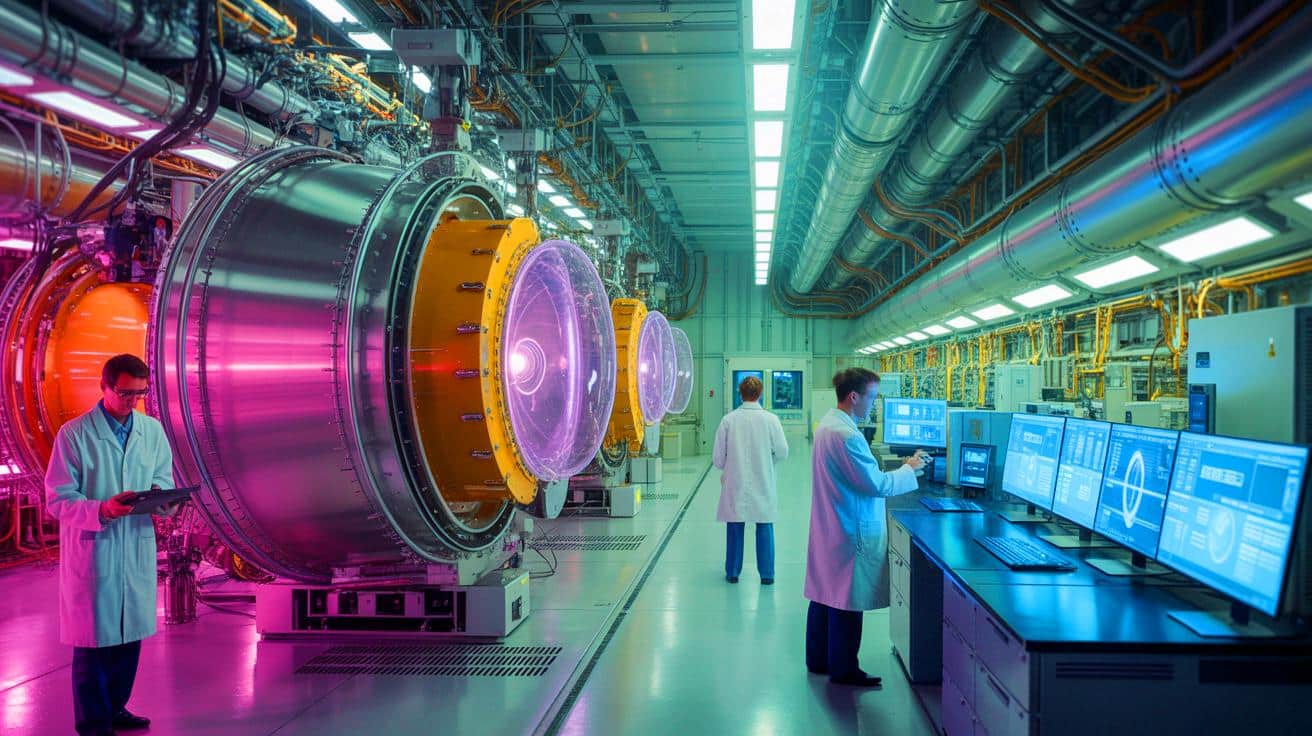
The success of this experiment hinged on the capabilities of the Mainz Microtron (MAMI), a pivotal instrument in modern physics research. MAMI provided a stable electron beam with high energy precision and low background noise, essential for exploring exotic nuclear structures. Coupled with the A1 Collaboration’s spectrometers, MAMI enabled the researchers to delve into the subtleties of nuclear physics with remarkable accuracy.
This collaboration allowed for the measurement of transient and previously unobservable phenomena, transforming theoretical concepts into tangible results. The synergy between advanced technology and scientific expertise at MAMI exemplifies the potential for groundbreaking discoveries in fundamental physics. How will future research build upon this achievement, and what new frontiers will it uncover in the realm of nuclear science?
This extraordinary accomplishment raises intriguing questions about the future of nuclear physics. As researchers continue to push the boundaries of what is possible, the synthesis of the six-neutron hydrogen isotope serves as a testament to human ingenuity and perseverance. What other theoretical frontiers await exploration, and how might they reshape our understanding of the universe?