




| IN A NUTSHELL |
|
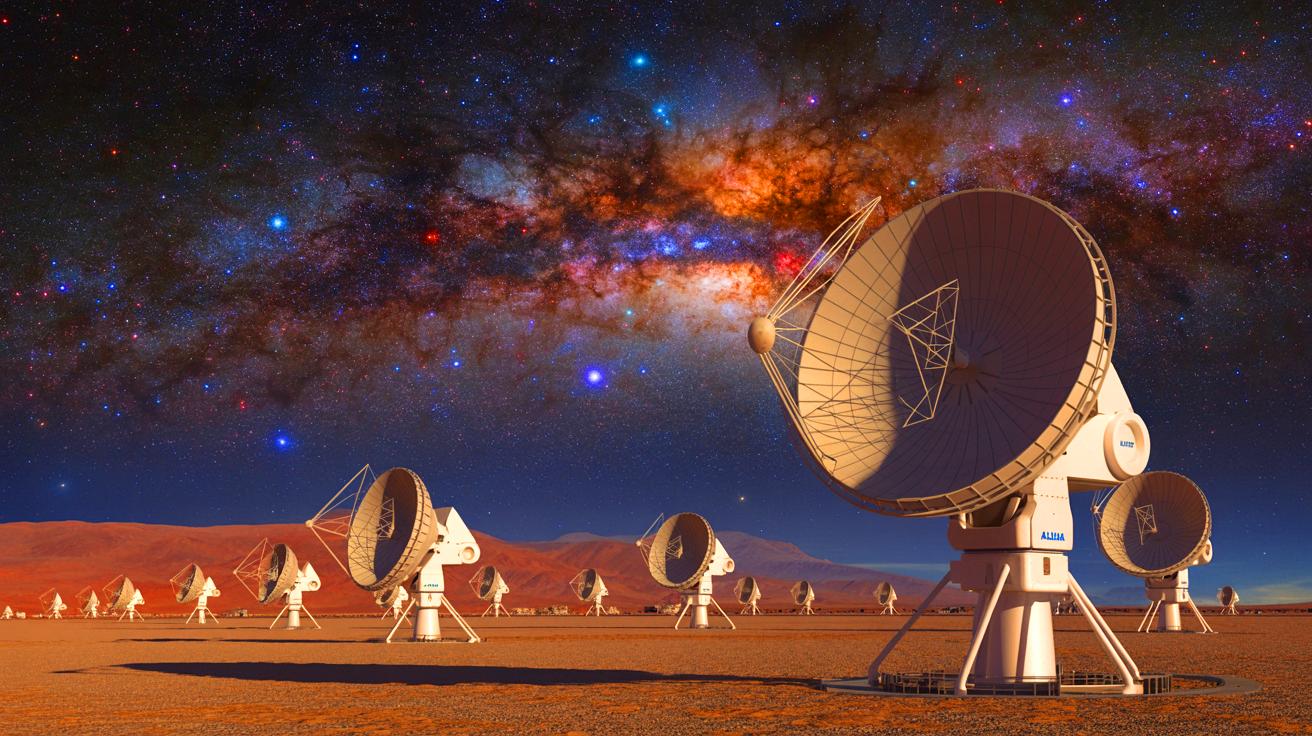
Astronomers have recently unveiled a groundbreaking discovery that significantly enhances our understanding of star formation in the galaxy’s most remote regions. Utilizing the Atacama Large Millimeter/submillimeter Array (ALMA) in Chile, researchers have captured groundbreaking images of protostellar outflows and jets within the Milky Way’s outer disk. This study focuses on a protostellar source, Sh 2-283-1a SMM1, situated approximately 26,000 light-years from Earth. The findings offer a rare glimpse into star formation processes in low-metallicity environments, akin to conditions in the early galaxy, and could reshape our understanding of stellar birth across diverse cosmic environments.
Revealing Pulsating Jets in Remote Regions
ALMA’s high-resolution imaging has uncovered a remarkable bipolar structure featuring narrow, high-velocity jets emanating from the protostar Sh 2-283-1a SMM1. These jets are surrounded by slower, broader outflows. By analyzing the motion of gas toward and away from Earth, scientists have charted these jets’ dynamics with unprecedented clarity. A significant revelation is that these jets are episodic, not continuous, occurring every 900 to 4,000 years. This pulsating rhythm plays a crucial role in regulating the young star’s growth by allowing it to accrete matter while shedding excess mass. While such episodic outflows have been observed in nearby star-forming regions, this marks the first instance of such behavior detected over 15 kiloparsecs from the Galactic Centre. This finding suggests that the physical processes governing star formation remain consistent even in chemically diverse environments.
Unusual Chemistry in Star Formation
Although the physics of jet formation appears universal, the chemical signatures in Sh 2-283-1a SMM1 are distinct. Measurements of carbon monoxide (CO) and silicon monoxide (SiO) reveal unusually low SiO-to-CO ratios compared to protostars closer to the Sun. This indicates that the shock chemistry and dust properties in the outer galaxy significantly differ due to the scarcity of heavy elements in this region. The protostar is also identified as a ‘hot core,’ a warm, chemically rich area often associated with complex organic molecules. Only one other hot core has been confirmed so far out in the galaxy, underscoring the rarity of such chemically active environments in low-metallicity regions. The luminosity of Sh 2-283-1a SMM1 is estimated to be about 6,700 times that of the Sun, categorizing it in the intermediate- to high-mass range.
Beyond the Galactic Core: Extending Star Formation Studies
ALMA’s observations have detected molecular outflows from four additional sources within the galaxy’s outer regions, demonstrating that star formation is both active and widespread in these distant environments. Previously, detailed studies of protostellar jets were limited to regions only a few thousand light-years from Earth. By extending research to the galaxy’s outskirts, astronomers can test long-standing models of stellar birth under more primitive conditions. These results bridge modern star formation with cosmic history, as low-metallicity environments resemble early Universe conditions. Understanding star formation in these settings provides insights into the processes that ignited the first generations of stars and shaped today’s galaxies.
Implications for Future Research
The research team intends to expand its survey to cover more protostars in the Milky Way’s outer regions. By examining episodic jet cycles and molecular abundances across different environments, scientists aim to determine if metallicity directly influences the rhythm and chemistry of stellar birth. The findings also pave the way for investigating how planetary systems might form in chemically diverse environments. If the fundamental physics of star formation remains constant, planetary systems may arise even in conditions once deemed inhospitable. This landmark study demonstrates that while the chemistry of star formation may vary with the environment, the underlying physics remains consistent across the Milky Way. By capturing the first resolved protostellar jets this far from the Galactic Centre, astronomers confirm that the processes shaping stars near the Sun are universal, extending to the galaxy’s far reaches.
The discovery of protostellar jets in the Milky Way’s remote regions marks a significant advancement in our understanding of star formation. By revealing that the physics of star birth remains consistent across chemically diverse environments, this research challenges previous assumptions and opens new avenues for exploration. As scientists continue to investigate these enigmatic processes, what other mysteries of the universe might they uncover? How will our understanding of star and planet formation evolve as we probe further into the cosmos?