



| IN A NUTSHELL |
|
The race for dominance in the global battery industry is more intense than ever, with Europe, Asia, and the United States vying for leadership in the energy transition value chain. Batteries are central to this competition, playing a crucial role in powering electric vehicles and supporting renewable energy sources. However, the European battery industry faces significant challenges, particularly in the realm of testing and validation. Traditional physical testing methods are time-consuming and resource-intensive, hindering the industry’s ability to innovate rapidly. In response, the Horizon Europe project THOR aims to revolutionize battery testing through digitalization, creating predictive digital twins that promise to transform the industry.
Revolutionizing Battery Testing with Digital Twins
In an effort to streamline the battery testing process, the THOR project is spearheading the development of digital twins. These virtual replicas of physical batteries are designed to simulate performance, lifespan, and safety with high accuracy. By replacing traditional physical tests with digital simulations, THOR aims to reduce the reliance on costly and time-consuming physical testing by at least 50%. This approach not only accelerates the design process but also significantly reduces costs, providing a competitive edge for the European battery industry.
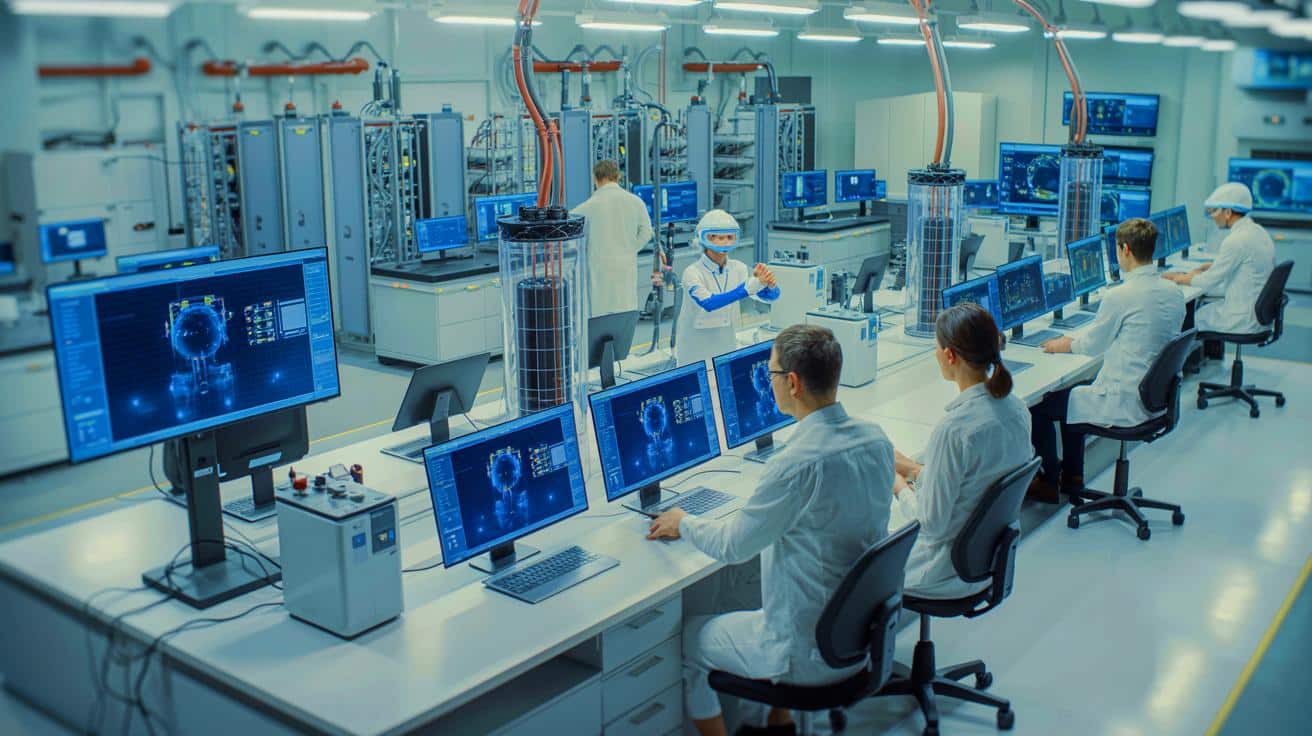
Digital twins offer a dynamic environment where batteries can be tested under various conditions without the need for physical prototypes. This virtual testing environment allows for the generation of richer datasets, which can be used to optimize battery design, usage, and maintenance strategies. The project is developing three predictive models at the cell, module, and pack levels, all integrated into a single platform. This system will provide real-time visualizations of capacity fade, thermal gradients, and safety margins, facilitating faster and more informed engineering decisions.
Collaborative Efforts Across Europe
The success of the THOR project hinges on a collaborative effort involving a pan-European consortium of experts from various fields. Organizations such as CEA (France), INERIS (France), and VUB (Belgium) contribute their expertise in experimental testing, data generation, and model calibration. FEAC (Greece) is responsible for developing the hybrid digital twin framework and integrating AI technologies. Meanwhile, companies like Varta Innovation (Austria), Flash Battery (Italy), and ENGIE-Laborelec (Belgium) provide prototype cells, modules, and battery packs, ensuring the models are validated under real-world conditions.
This cross-sector and transnational collaboration leverages advanced infrastructure, including pilot-scale manufacturing lines and high-performance computing facilities. By combining experimental, computational, and industrial expertise, THOR ensures that the digital twin is not only scientifically robust but also industrially validated across the entire European battery value chain.
Harnessing Advanced Technologies
The THOR project employs a hybrid strategy that combines physics-based high-fidelity models with AI-driven approaches. Multiphysics simulations capture the electrochemical, thermal, and mechanical phenomena within batteries, while machine learning enhances predictive capacity by analyzing large experimental datasets. This hybrid strategy requires harmonized data formats to ensure interoperability and efficient use of big data and AI techniques.
By merging models with experimental evidence, THOR aims to create a scalable digital twin capable of real-time, multi-scale predictions. The digital twin operates through a graphical interface that delivers real-time predictions of performance, safety, and aging. By transforming battery testing from a retrospective to a predictive process, THOR enables faster innovation cycles and more reliable product qualification.
Real-World Applications and Future Prospects
THOR’s digital twin technology is already making significant strides in the industry. Varta Innovation has manufactured cells and, in collaboration with Flash Battery, distributed 757 cylindrical 21700 cells with NMC/Graphite and LFP/Graphite chemistries, two of the most widely used configurations in the market. Extensive testing campaigns conducted by CEA, VUB, and INERIS have calibrated high-fidelity models, establishing new experimental methodologies.
The project is now entering a new phase, focusing on upscaling models to pack and module levels to ensure predictive accuracy at higher system scales. As the digital twin technology continues to evolve, it promises to deliver measurable benefits across the supply chain, including higher production efficiency, reduced operating costs, enhanced safety, and improved sustainability. THOR’s work underscores the potential of digital twins to achieve results comparable to physical testing, paving the way for future updates to international standards on safety, energy efficiency, and battery management.
The THOR project exemplifies the transformative potential of digitalization in the battery industry. By harnessing advanced technologies and fostering collaborative efforts, it aims to overcome the persistent bottlenecks in traditional battery testing methods. As the project progresses, the question remains: How will digital twins continue to shape the future of battery development and innovation on a global scale?