



| IN A NUTSHELL |
|
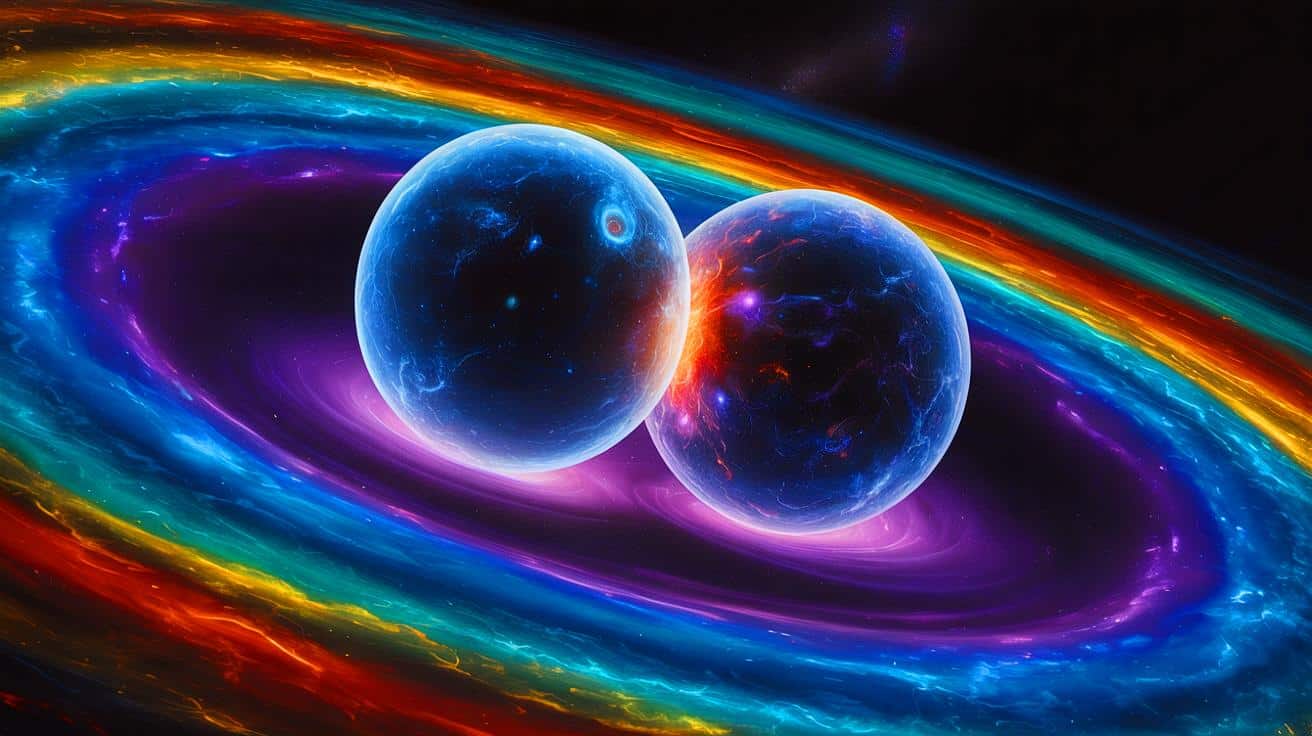
The universe once again surprises us with its mysteries as astronomers have confirmed the largest known black hole merger. This astronomical event, detected by the LIGO-Virgo-KAGRA collaboration, involves two massive black holes merging to form a new black hole over 225 times the mass of our Sun. This discovery not only challenges existing scientific theories but also marks a significant milestone for gravitational-wave astronomy. The detection, initially observed on November 23, 2023, is already reshaping our understanding of the most extreme objects in the cosmos, pushing the boundaries of our knowledge further than ever before.
The Power of Global Collaboration
The unprecedented detection of this massive black hole merger was made possible through the remarkable international collaboration known as the LIGO-Virgo-KAGRA (LVK) Collaboration. This global effort involves over 2,000 scientists from more than 300 institutions worldwide, each contributing to the groundbreaking discovery. The collaboration harnesses the unique strengths of three major observatories: LIGO in the United States, Virgo in Italy, and KAGRA in Japan.
LIGO, operated by Caltech and MIT, is supported by the U.S. National Science Foundation and international partners, while Virgo is managed by the European Gravitational Observatory with funding from various European research agencies. KAGRA, located in Japan, is hosted by the University of Tokyo’s Institute for Cosmic Ray Research. Together, these facilities form a global network capable of triangulating cosmic events with exceptional precision, leading to the confirmation of this extraordinary merger.
Breaking the Boundaries of Stellar Evolution
The merger, dubbed GW231123, presents a puzzle not just due to its massive scale but also because of the intense spin of the merging black holes. The rapid rotation and unusually high mass of these black holes suggest a complex formation history, potentially involving previous black hole mergers. This challenges traditional theories of stellar evolution, which predict an upper limit for black hole masses formed from dying stars.
These recent observations push far beyond those limits, suggesting the need for new models to explain the existence of such supermassive objects. Theories involving hierarchical mergers, where successive collisions and fusions of smaller black holes occur, are gaining traction. Such insights underscore the necessity for innovative theoretical frameworks and more sophisticated models of stellar evolution and black hole formation.
Pushing the Limits of Gravitational-Wave Detection
The discovery of GW231123 not only redefines our understanding of black hole masses but also pushes the technological and analytical limits of gravitational-wave astronomy. Accurately interpreting the signal from this event required advanced modeling that accounted for the chaotic behavior of spinning black holes. This achievement, once deemed impossible just a few years ago, demonstrates the extraordinary capabilities of next-generation gravitational-wave detectors.
These technological advancements are part of the fourth observing run, which began in May 2023. This run is the longest and most sensitive observation campaign to date, promising many more discoveries in the coming years. With results from the first half of this run expected later this summer, the scientific community eagerly anticipates what other cosmic secrets might be uncovered.
A New Era for Black Hole Astronomy
GW231123 surpasses the previous record-holder, GW190521, which involved black holes with a combined mass of 140 solar masses. With over 100 black hole mergers cataloged since the first detection in 2015, each new event adds vital pieces to the cosmic puzzle. This particular black hole merger offers new insights into the lifecycle of massive celestial bodies and the nature of spacetime itself.
The findings underscore the need for evolving theoretical frameworks and more sophisticated models to understand how black holes form, grow, and interact. As the LVK Collaboration continues to support open science by releasing data after publication, the broader scientific community is empowered to conduct further analysis, accelerating the pace of discovery and deepening our understanding of these extreme phenomena.
As we continue to push the boundaries of our cosmic knowledge, the universe consistently challenges and amazes us with its mysteries. The discovery of the largest black hole merger ever recorded is just the beginning of a new era in gravitational-wave astronomy. With ongoing advancements in technology and analytical methods, what other profound secrets of the universe might we uncover in the near future?