


| IN A NUTSHELL |
|
In a groundbreaking development, Brown University engineers have unveiled a novel microscopic imaging technique that leverages quantum entanglement to capture 3D images. This innovation, championed by undergraduate students Moe (Yameng) Zhang and Wenyu Liu, promises to revolutionize the field of holography by addressing the persistent challenge of phase wrapping. Under the guidance of senior research associate Petr Moroshkin and Professor Jimmy Xu, these students are pushing the boundaries of what is possible in quantum imaging. Their work, recently presented at the Conference on Lasers and Electro-Optics, highlights the potential for new applications in both scientific research and medical diagnostics.
Illuminating the Target
The core of this new imaging technique lies in its use of two light spectra. By utilizing infrared light to illuminate the target and visible light entangled with the infrared to capture the image, the technique advances the field of microscopic imaging. This process not only records the intensity of light but also its phase, producing true holographic images. Zhang, a junior concentrating in engineering physics, described the technique as Quantum Multi-Wavelength Holography, which allows for more accurate 3D imaging by gathering better information on the object’s thickness through indirect photons.
Professor Xu expressed astonishment at the students’ achievements, noting that their method effectively achieves infrared imaging without an infrared camera. This breakthrough enables exceptional depth resolution in the images it produces. The ability to create precise 3D images using this technique marks a significant leap forward in the field of quantum imaging.
How the Microscopic Imaging Works
Standard imaging techniques, such as X-rays and traditional photography, capture light reflected off an object. In contrast, quantum imaging relies on the phenomenon of quantum entanglement, often described as “spooky action at a distance.” This principle implies that once two photons are entangled, any change to one photon immediately affects the other, regardless of the distance separating them. In this context, one photon acts as the “ler” to scan the target, while detecting the entangled “signal” photon allows researchers to produce an image.
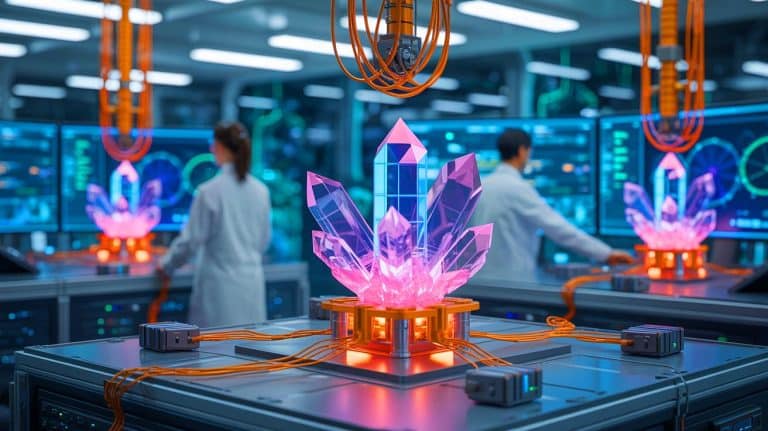
The Brown engineers employed a nonlinear crystal to generate lers from photons with infrared wavelengths entangled with visible wavelength signal photons. This combination, infrared illumination and visible light rendering, proved to be the most effective. Liu, a senior in engineering physics and applied math, emphasized that while infrared wavelengths are ideal for biological imaging due to their ability to penetrate skin, they typically require costly infrared detectors. The innovative approach allows for the use of standard, less expensive silicon detectors, thus broadening its accessibility and potential applications.
Overcoming Phase Wrapping
A significant hurdle in creating 3D quantum images is the issue of phase wrapping. This occurs when imaging techniques use the phase of light waves to determine depth but encounter a wrap-around effect where deeper features appear at the same depth as shallower features within the same wave cycle. To address this, the Brown team utilized two sets of entangled photons at different wavelengths. This approach significantly enhanced depth measurement accuracy, providing a more precise image.
By employing two slightly different wavelengths, the researchers effectively generated a much longer synthetic wavelength, approximately 25 times longer than the originals. As a result, they achieved a broader measurable range that is more applicable to biological materials. This technique was successfully demonstrated by imaging a 1.5-millimeter metal letter “B,” showcasing the high-fidelity 3D images possible through quantum entanglement. Liu’s work earned him the School of Engineering’s Ionata award for unusual creativity and imagination.
The Future of Quantum Imaging
The potential applications of this quantum imaging technique are vast, with implications for fields such as medical diagnostics, materials science, and biological research. By overcoming the limitations of traditional imaging methods, this innovation opens the door to new possibilities in non-invasive imaging and precise 3D reconstructions. The ability to use affordable silicon detectors further enhances its practicality and accessibility.
As Zhang and Liu presented their findings at the conference, they had the opportunity to engage with pioneers in the field, gaining insights and inspiration for future research endeavors. Their work not only demonstrates the capabilities of quantum entanglement in imaging but also sets the stage for further advancements in the technology. With continued exploration and experimentation, what other breakthroughs could quantum imaging unlock?