



| IN A NUTSHELL |
|
For over a year, four volunteers lived in complete isolation within a simulated Martian habitat created by NASA. The aim was to prepare for future manned missions to Mars. While scientific rigor and survival were central to the experience, video games, particularly strategy games, played a significant role. This experiment, part of NASA’s CHAPEA program, offered insights into the psychological and physical challenges of living in confined spaces for extended periods. The mission highlights the intersection of serious scientific endeavors with recreational activities, underscoring the importance of mental well-being during such isolating experiences.
A Full-Scale Simulation of Life on Mars
On June 25, 2023, NASA launched the first mission of the CHAPEA (Crew Health and Performance Exploration Analog) program. The initiative was designed to test living conditions on Mars without leaving Earth. The four crew members were confined for 378 days in a 1,722-square-foot 3D-printed habitat at the Johnson Space Center in Houston, Texas. This structure aimed to simulate extreme conditions: limited resources, homegrown food, extravehicular activities with spacesuits, and communications delayed by 22 minutes with “Earth.”
The habitat’s design was inspired by potential future Martian living modules, providing a realistic setting for the crew. The delayed communication simulated the actual time it would take for messages to travel between Earth and Mars. This delay required the crew to rely on their problem-solving skills and resourcefulness. The simulation provided crucial data for understanding the challenges of living on Mars, especially in terms of human factors, which are often overlooked in favor of technical details.
A Daily Routine of Challenges… and Leisure
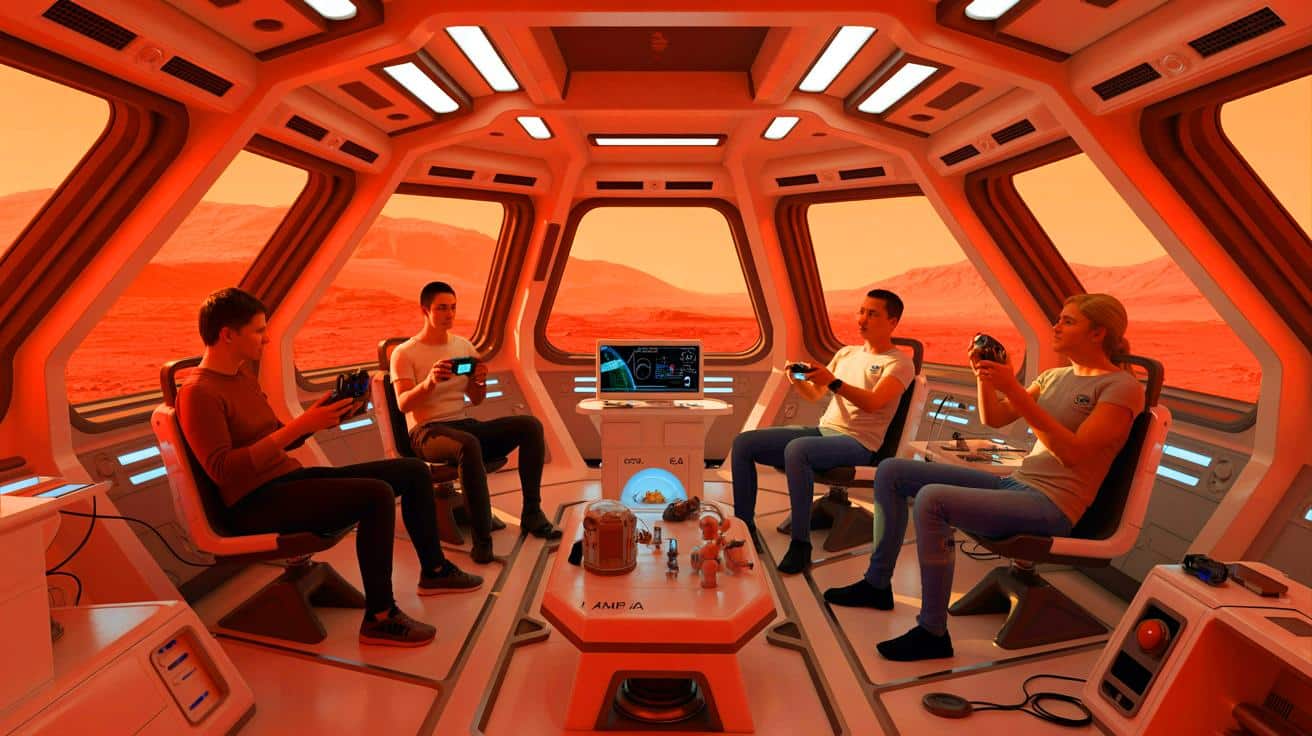
Although not a real scientific mission on Mars, the psychological and physical trials were no less daunting. A primary focus of the CHAPEA mission was observing how a group of humans could manage stress, solitude, and boredom during prolonged isolation in a confined space. To occupy their free time and preserve mental health, crew members engaged in various activities: movies, series, preloaded books, painting, and a well-stocked PlayStation 4. Marine microbiologist Anca Selariu, one of the crew members, shared these insights.
These leisure activities were more than mere distractions; they were vital for mental well-being. The crew had to maintain their psychological health to ensure the mission’s success. The availability of entertainment options helped mitigate the effects of isolation, providing a sense of normalcy and comfort. The experiment highlighted the importance of including such recreational activities in future space missions to promote mental health and overall mission success.
Strategy for Maintaining Balance
Among the games included, strategy and construction simulation titles were particularly popular. This choice was intentional: these games require reflection, planning, and patience, qualities essential for a future space mission. They also indirectly tested cognitive and coordination skills in an isolated context. Participants reported that these gaming sessions were not just simple pastimes but genuine decompression bubbles, allowing them to maintain morale while stimulating decision-making abilities in a secure environment.
The inclusion of strategy games in the mission highlights the potential role of video games in cognitive training. By engaging in strategic thinking, the crew could maintain their mental sharpness, a crucial aspect of surviving and thriving in space. These activities provided a valuable outlet for stress, reinforcing the need for thoughtful recreational options in long-duration missions.
On the Road to Mars… Someday
NASA is already planning a second CHAPEA mission in 2025, with the potential for sending astronauts to Mars in the 2030s. This ambitious goal remains fraught with technical and budgetary uncertainties. However, these analogous experiences provide invaluable data on the human factors of long interplanetary expeditions. An unexpected lesson from the mission is that the future of space exploration will also involve intelligent entertainment. Even 140 million miles from Earth, a PS4 controller in hand could become a valuable ally for space pioneers.
These experiments demonstrate the importance of considering human needs in space exploration. As NASA and other space agencies plan for future missions, integrating recreational activities will be crucial for maintaining crew morale and mental health. This aspect of mission planning could be as vital as technical advancements. How will future missions balance the demands of survival and exploration with the need for mental health and well-being?